|
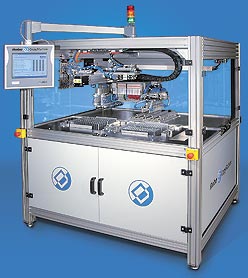
The Robo CopyStation M2 is a further development
of the first automated copying station worldwide Robo
CopyStation M1,
which has been introduced at CeBIT 2005 in Hanover.
The development of Robo CopyStation is based upon the experience
of many years in the field of copying
stations for mobile
memory media.
Robo CopyStation M2 convinces with high speed
rates and its complete automation. The high
throughput of more than one million memory cards per month guarantees
a
short return on investment.
Functionality
The Robo CopyStation M2 will copy the identical data images
to 48 cards simultaneously.
Blank memory cards are fed into
the system by so-called card trays via a transporting system.
From there the cards are picked up, 24 at a time, by
a cushion of suction pads and delivered to the copying unit.
After being imprinted, the cards are taken
to another stack of card trays.
The systems can be adjusted to a wide range of tray types.
The Robo CopyStation is operated using
a touch screen which
is mounted on a swivel arm.
The Robo CopyStation can be connected
to the company’s network since it is running on a standard
operating system.
An optional software tool is available from altec which encodes
the data individually for each card during copying according
to the card ID number. This technology can be used to ensure
that a program or game can only be started from the original
memory card. This provides an effective copy protection mechanism.
The currently achievable throughput
depends on capacity and speed of the cards as well as on
other factors as
tray type
etc. With 512 MB SD Cards, a throughput of 2000
cards per hour can be achieved (without verification).
The contact pads are currently
designed for SD Cards and MultiMediaCards, microSD as
well as RS-MMC. altec plans
to provide contact pads for other card types such as Memory
Stick PRO Duo, Memory Stick Micro M2 and miniSD in the near
future.
|
Available version (with item number)

Robo CopyStation M2 – 29AL1201
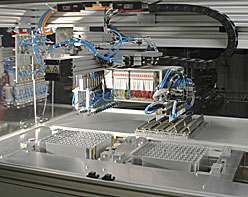
above: In front card trays with unprogrammed (left)
and programmed cards (right). In the background contact pads where the
memory cards are programmed
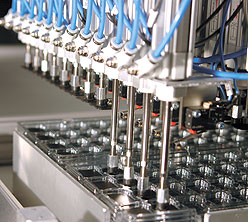
above: The robot arm picks up the memory
cards using suction pads
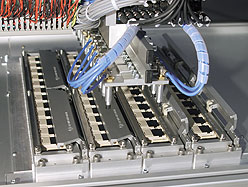
above: Close up view of the 48 contact pads

above: scene from
the animation |